


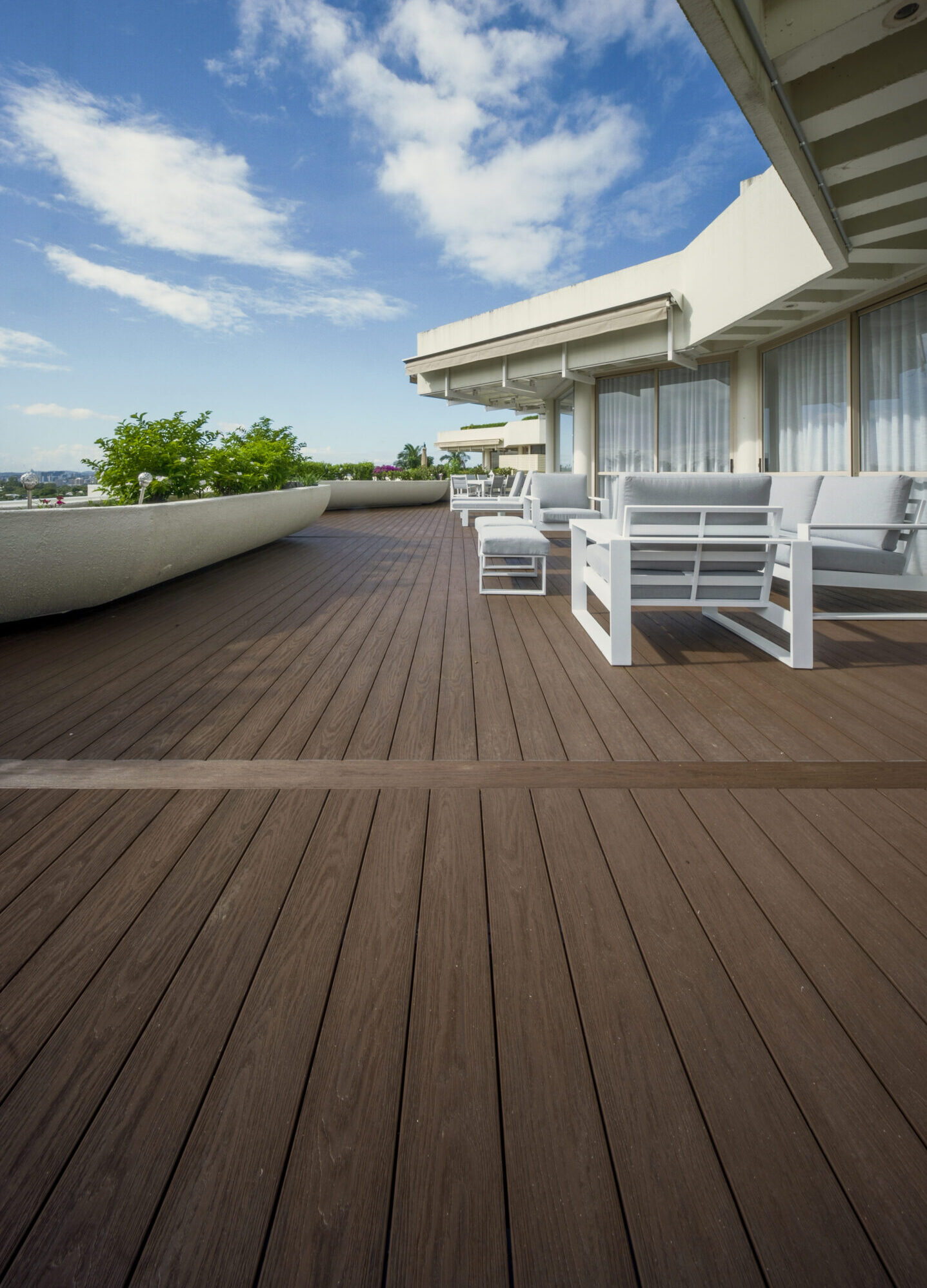
Search “best composite decking Australia” and you’ll find dozens of brands that all claim to be low maintenance, long lasting and built for our climate. Some are. Many were designed for colder, gentler markets and simply rebadged here. The way to tell them apart is to look past the brochure and check a handful of things any good supplier should be able to answer straight away.
Here are the nine we’d check, whoever you end up buying from.
1. Is the board capped, and on how many sides?
Early composite boards were “uncapped”: a blend of wood fibre and plastic with nothing protecting the surface. They faded, stained and soaked up moisture. Modern boards have a protective polymer cap around the core, which is what gives them their stain, fade and moisture resistance.
Ask what the cap is made of and whether it covers the whole board. HOME boards use an HDPE cap over a wood-plastic composite (WPC) core. ADVANCED boards use an ASA cap over a foamed PVC core.
2. WPC or PVC?
Composite decking comes in two main types.
| WPC (e.g. HOME) | PVC (e.g. ADVANCED) | |
|---|---|---|
| Core | Wood fibre blended with recycled plastic | Foamed PVC, no wood content |
| Typical strengths | Natural feel, better value | Higher slip resistance, longer warranty |
| Approx. board price | From around $125/m² | From around $190/m² |
Prices are approximate supply prices for boards only and exclude the subframe, fixings and installation.
Neither type is “better” across the board. WPC suits most backyards. PVC earns its higher price around pools, on commercial jobs and anywhere slip resistance matters most. Our guide to WPC decking explains the difference in more detail.
3. What’s the tested slip rating?
In Australia, slip resistance is tested under AS 4586. You’ll see two kinds of result:
- P ratings (P0 to P5) come from a wet pendulum test, which mimics a foot slipping on a wet surface. P5 is the highest class.
- R ratings (R9 to R13) come from an inclining ramp test, where a tester in safety shoes walks a ramp coated in oil. R13 is the highest class.
“Non-slip” on a brochure means nothing without a number. HOME is rated R11. ADVANCED is rated R13 and P5, which is why it’s the usual pick for pool surrounds and ramps.
4. Does it have a bushfire rating, and up to what level?
Much of Australia is bushfire prone, and your building approval may require decking that meets a specific Bushfire Attack Level (BAL). Ask for the BAL the product is tested to and the conditions that come with it.
Both WoodEvo decking ranges are certified for use in bushfire-prone areas up to and including BAL-29. Not sure what your address needs? Check it on our bushfire prone area map, then confirm with your building surveyor.
5. Is it CodeMark certified?
CodeMark is a national certification scheme that confirms a building product meets the relevant parts of the National Construction Code. For builders and certifiers, it makes approvals simpler because the compliance work has already been done and documented.
Ask to see the certificate itself, not just a logo. A real certificate has a number, an expiry date and a list of conditions.
6. What does the warranty actually cover?
A long warranty headline is easy to print. The detail is what matters:
- How long is it for homes, and how long for commercial use?
- Does it cover fading, staining and structural failure, or only manufacturing defects?
- Is it only valid if a particular fixing system or joist spacing is used?
- Does it pass to the next owner if you sell?
HOME carries a 25-year residential warranty (10 years commercial), and ADVANCED carries 30 years residential (15 years commercial). Like most decking warranties, ours covers the original purchaser and requires installation to our guidelines.
7. How hot does it get in summer?
Any solid surface warms up in direct Australian sun, and darker colours get hotter. If your deck faces north or west or sits next to a pool, ask what the supplier does about heat.
Lighter colours in our ranges use NatureCool™ technology, which reflects more sunlight so the surface stays cooler than standard boards of a similar shade. Colour choice is still the biggest factor, so check samples in the sun before you decide.
8. How is it fixed, and what frame does it need?
Hidden clip systems give a cleaner finish with no screw heads on top, and they let boards expand and contract properly. Check:
- the fixing system the supplier recommends
- the maximum joist spacing, because closer joists mean a dearer frame
- the ground clearance it needs for ventilation
Our boards need at least 150 mm clearance over soil. Joist spacing ranges from 350 mm to 450 mm depending on the board and use.
9. Can you see it before you buy?
Photos never show texture or true colour. Colour can also vary slightly between production batches, so a good supplier will tell you to order your whole job at once. Always get samples and look at them outside, in the light your deck will actually get.
The short version
The best composite decking for an Australian home is fully capped, has tested slip and bushfire ratings, carries a certification you can verify, and comes with a warranty you’ve read. If a supplier can’t answer these nine questions clearly, keep looking.
When you’re ready to compare, look through the HOME and ADVANCED ranges, or order a free sample kit and see the boards for yourself.
Frequently asked questions
What is the best composite decking in Australia?
The best board is the one that suits your site. For most backyards, a capped WPC board with an R11 slip rating and a BAL-29 rating is a strong choice. Around pools or on commercial jobs, a PVC board with R13/P5 slip ratings is worth the extra cost.
Is composite decking worth it compared with timber?
It usually costs more upfront than treated pine but needs no sanding, oiling or staining. Over the life of the deck the gap closes. See our composite vs timber cost guide.
How long does composite decking last?
Quality capped boards are built to last decades. Ours carry 25-year (HOME) and 30-year (ADVANCED) residential warranties when installed to our guidelines.
Does composite decking need special joists?
It needs a flat, strong subframe with joists at the spacing the manufacturer specifies, usually closer together than for hardwood. Check the installation guide before you build the frame.
See WoodEvo for yourself
Order free samples, or get matched with an accredited installer near you.
Similar Articles
Composite Decking in Australia: The Honest Pros and Cons Guide
Does Composite Decking Add Value to Your Home?
What Is WPC Decking and Why It’s Perfect for Australian Weather

Analysing the True Composite Decking Cost vs Timber
Plastic Decking Myths Busted: Sustainability and Durability

Why WoodEvo is Rated the Best Composite Decking in Australia